

In March, someone moved $1 million worth of Bitcoin through a large crypto custodian. Three weeks later, almost exactly the same amount came back. Incredibly, less than two months after that, the Bitcoin was deliberately destroyed.
The wallet had been dormant for almost 12 years before it suddenly sprang back to life. Bitcoin educator Bennet noted it sent 20.00010537 BTC to “a custodian of some kind” before receiving it back again (minus $3 or so).
“The whole balance went out to what looks like an exchange hot wallet, and almost exactly the same amount came back three weeks later. Seven weeks after that, it was burned.”
The mystery BTC transaction is part of a wider enigma surrounding 107 BTC burned in May, worth roughly $8.5 million at the time.
New blockchain analysis shows that five wallets that ultimately destroyed their Bitcoin appear to have been controlled by the same person. It was likely an early Bitcoin holder who had funds on the collapsed Mt. Gox exchange.
But why on earth would anyone deliberately destroy millions of dollars worth of Bitcoin?
The BTC wallets behind the burn
The five addresses that eventually sent their Bitcoin to an unspendable address show “strong indicators of common ownership” according to Chainalysis.
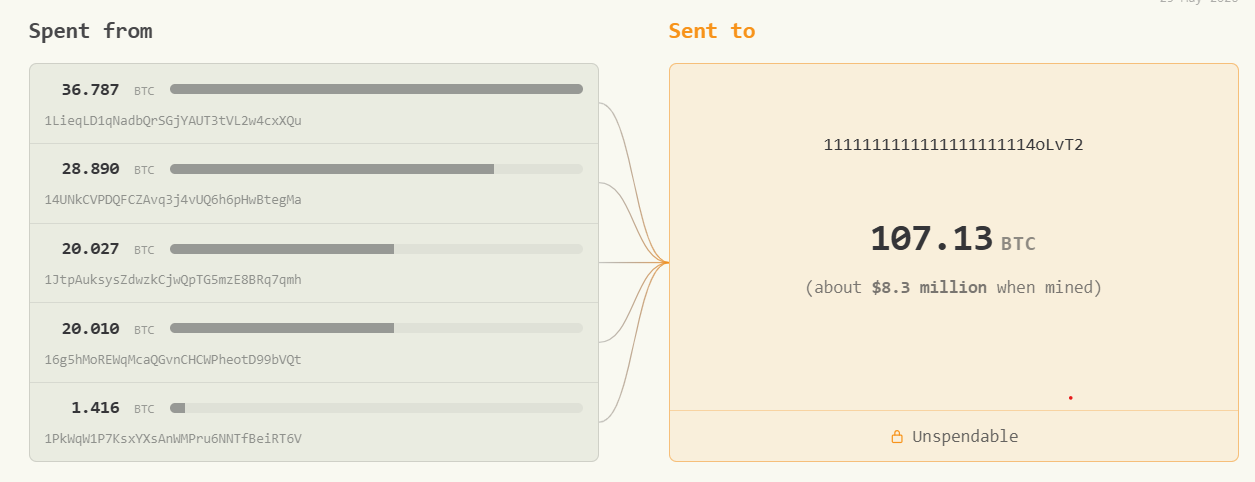
How to destroy Bitcoin. Source: Bennet.org
All five wallets were initially funded on the same day in April 2014, and each subsequently sent almost the same dollar-equivalent amount of BTC to the same deposit address at a large centralized exchange.
Related: Bitcoin faces true demand test above $83K as liquidity thickens: Glassnode
The addresses also seem to have operated on a rotational basis: one would send Bitcoin to the exchange until its activity stopped, then another would take over with transactions of a “similar cadence and value.”
Most of the funds, Chainalysis says, can be traced back to Mt. Gox, “suggesting the owner was an early adopter of Bitcoin.”
That doesn’t necessarily mean the coins were withdrawn directly from Mt. Gox, since the exchange ceased trading in February 2014, and the five wallets were funded in April. Bennet says:
“It’s entirely possible that the owner of these coins was one of the lucky ones who managed to get their coins off the exchange before it collapsed.”
The custodian itself remains unidentified. Chainalysis confirms it’s a large centralized exchange but says it does not publicly disclose the names of services it identifies.
Bennet’s analysis suggests the address behaves like a static customer deposit address at a large custodian.
That’s because the address doesn’t maintain a balance, and the deposits are swept into transactions containing dozens of other inputs before being consolidated into an omnibus wallet.
Once the Bitcoin enters the custodian’s system, the public blockchain can no longer tell us what happened to those coins. And that makes the wallet’s earlier activity even more intriguing.
The $10,400 clue
One of the five addresses sent 19.6 BTC in 60 transactions to the custodian between 2022 and 2024.
The Bitcoin amounts were vastly different, ranging from about 0.15 BTC to 0.62 BTC. But when measured in dollars, the transactions reveal extraordinary similarities.
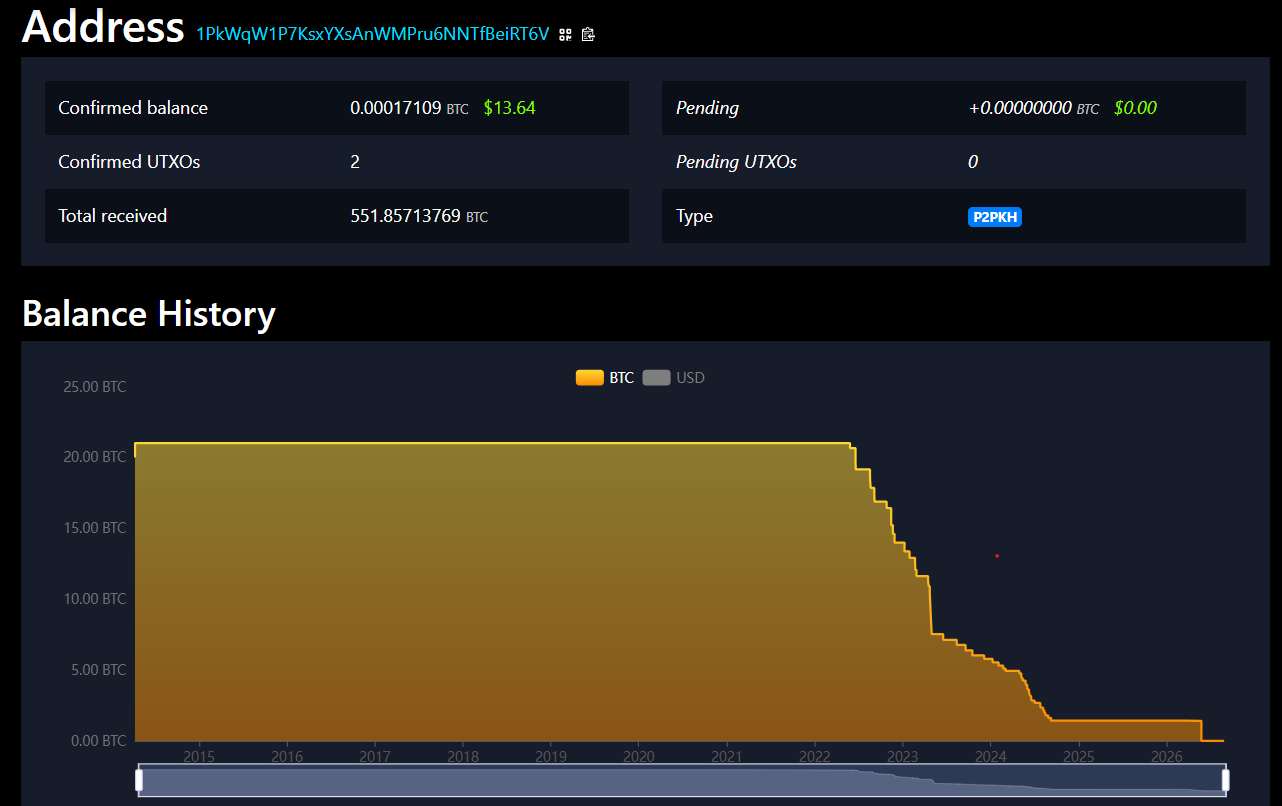
This address sent 19.6 BTC in 60 transactions to the same custodian. Source: Mempool.space
Despite Bitcoin’s price more than quadrupling during the period, 58 of the 60 transfers were within 10% of approximately $10,400 when they were sent.
So, while the owner wasn’t repeatedly sending the same amount of BTC, they were repeatedly sending almost the same dollar amount. Bennet says:
“This suggests to me a planned liquidation strategy.”
There is no way to prove this theory from the blockchain, since the BTC was mixed with large numbers of other coins once it reached the custodian, and the data doesn’t show whether the Bitcoin was sold, held or transferred elsewhere.
Related: Bitget CEO isn’t buying the Bitcoin rally — She’s waiting for $50K
Interestingly, “while payment size was constant,” Bennet says, “frequency was not — these $10k transfers came in clusters,” which could be more consistent with someone sending fixed-dollar amounts when required rather than following an automated schedule.
The $1 million round trip
While the $10,400 transactions offer a possible explanation for the wallet owner’s earlier relationship with the custodian, they do not help explain the $1 million round trip that happened in March.
After sitting untouched for roughly 12 years, the wallet suddenly moved its entire balance of 20.00010537 BTC and received 20.00006037 BTC back, a difference of just 4,500 satoshis, or around $3.
That weighs against the idea that the owner was simply trading the Bitcoin, since whatever happened inside the custodian, almost exactly the same amount came back.
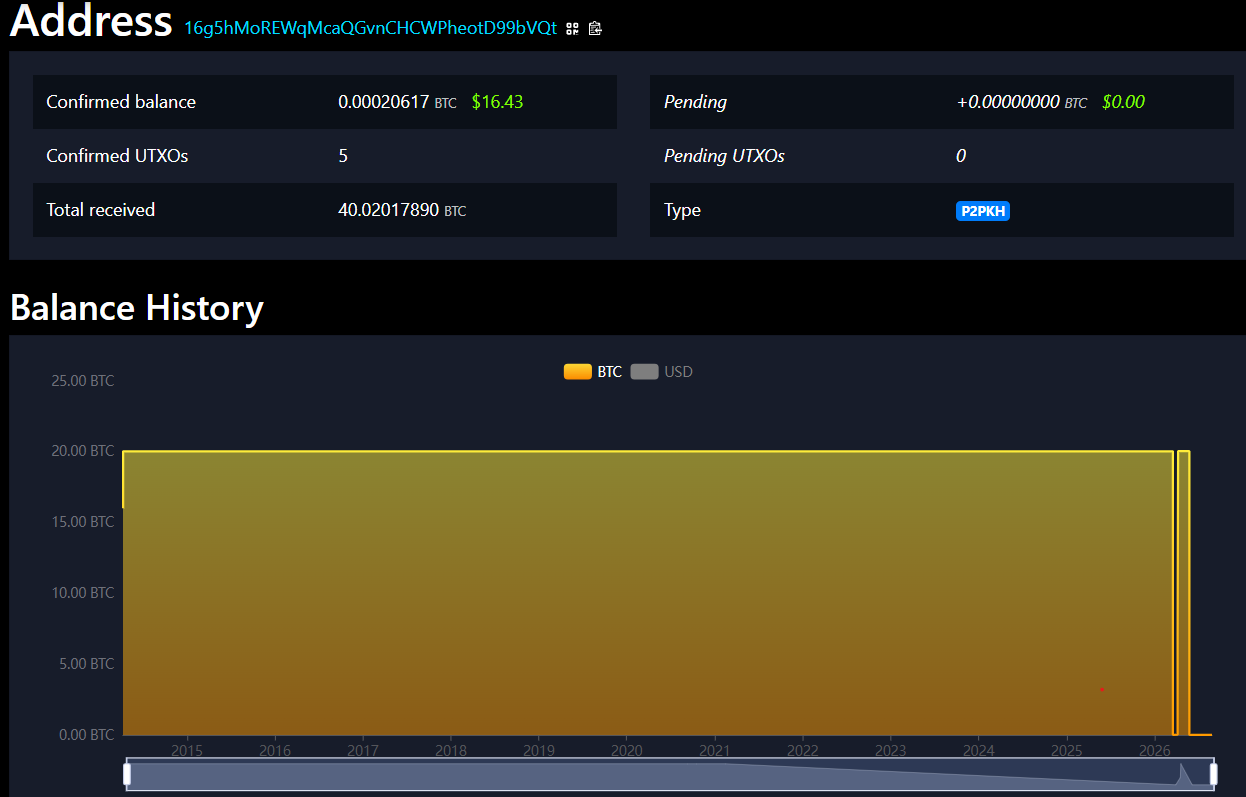
This address sent 20 BTC and received 20 BTC back. Source: Mempool.space
The returned Bitcoin was also split into three transactions of 7 BTC, 7 BTC and 6.00006037 BTC, sent over three consecutive days.
Bennet says the round numbers are consistent with a daily withdrawal limit imposed by the custodian. Crucially, the Bitcoin didn’t simply end up in another wallet; it returned to the same address that had sent it.
The transaction history also indicates that the same key holder controlled the coins before and after the round trip, Bennet says: spending the Bitcoin in March required the private key, while burning it in May required the same key again.
That makes the sequence particularly difficult to explain as a conventional exchange transaction.
So why did they do it?
There are several possibilities, but none fits all of the evidence. The liquidation theory makes some sense of the earlier transactions, but it doesn’t explain why the owner would send roughly $1 million through the same infrastructure in March and then retrieve virtually all of it.
Perhaps the owner was testing an old wallet or custody arrangement after 12 years of dormancy, moving the coins through a major custodian and successfully getting them back to show that an old key and custody setup still worked. But then, why destroy the Bitcoin afterward?
Tax or compliance reasons could potentially explain why someone moved an old stash through a major custodian, but then, there is no evidence linking the transaction to a particular tax or regulatory event.
There is also a privacy explanation. Sending Bitcoin through a custodian that sweeps deposits into an omnibus wallet makes the subsequent movement of those coins much harder to follow onchain. That’s certainly plausible but still provides no clues as to their ultimate destruction.
Perhaps the Bitcoin burn itself was intended as some kind of statement. Yet beyond a few blockchain sleuths, the action almost went unnoticed.
Burning Bitcoin is irreversible, so whoever controls the private keys chose to send the coins somewhere they can never be spent again, rather than simply leaving them untouched. Bennet says:
“There’s also the possibility that a very wealthy individual without heirs decided to permanently burn their coins (thereby publicly reducing the total bitcoin supply), rather than just destroying their keys.”
For now, even the firms best placed to analyze the blockchain are at a loss. Chainalysis concedes:
“We don’t have a clear explanation for why the owner would move a long-dormant stash through a custodian, retrieve roughly the same amount, and then deliberately burn it.”
While the blockchain can give us an unusually detailed record of what happened, it can’t tell us why. For now, at least, that remains the million-dollar question.
Magazine: El Salvador’s Bitcoin experiment turns 5: ‘It was for us, not them’
Cointelegraph publishes long-form journalism, analysis and narrative reporting produced by Cointelegraph’s in-house editorial team with subject-matter expertise. All articles are edited and reviewed by Cointelegraph editors in line with our editorial standards. Some articles contain affiliate links, from which Cointelegraph may earn a commission. These relationships do not influence which products we review or our editorial conclusions. Content published in here does not constitute financial, legal or investment advice. Readers should conduct their own research and consult qualified professionals where appropriate. Cointelegraph maintains full editorial independence.
