
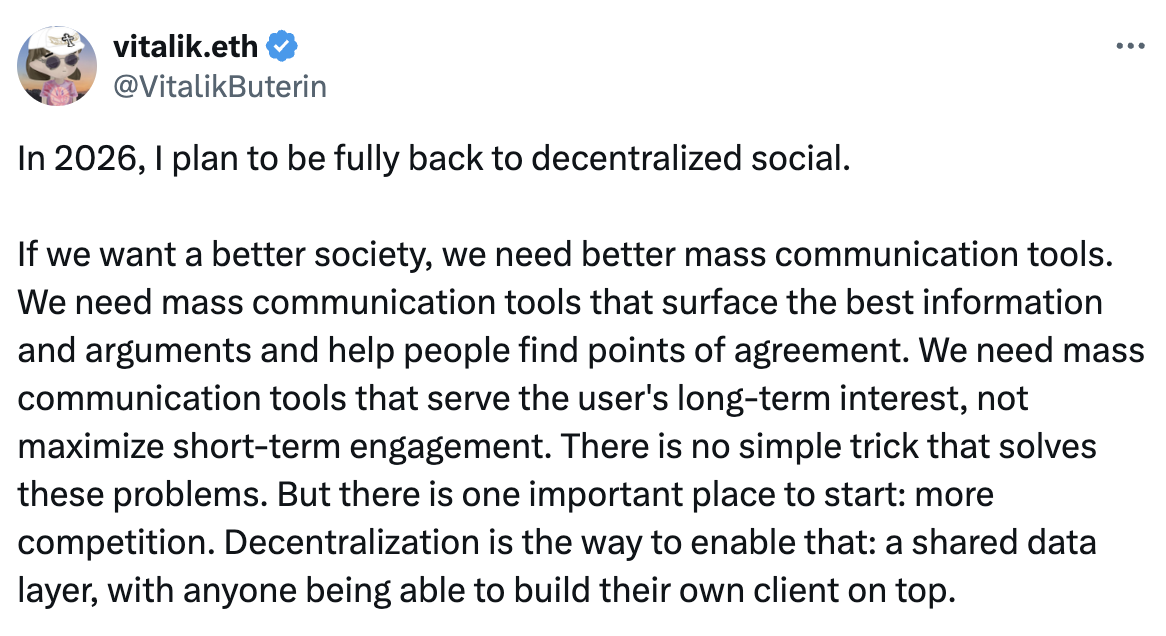
Ethereum co-founder Vitalik Buterin said he plans to fully recommit to decentralized social media in 2026, arguing that only platforms built on shared, decentralized data layers can foster real competition and support mass communication systems aligned with users’ interests rather than engagement metrics.
In a Wednesday post on X, Buterin said he has shifted his activity toward decentralized social platforms this year, noting that every post he has written or read in 2026 has been accessed through Firefly, a multi-client interface that supports X, Lens, Farcaster and Bluesky.
“If we want a better society, we need better mass communication tools,” Buterin said, arguing that decentralization enables competition by allowing multiple clients to operate on a shared social data layer.

Buterin criticized many crypto-native social projects for relying on speculative tokens as a substitute for meaningful innovation, arguing that SocialFi experiments have repeatedly failed by rewarding pre-existing social capital and short-term price speculation instead of content quality and constructive discourse.
He contrasted these efforts with creator-subscription models such as Substack, which he said better align incentives around high-quality content.
Calling for broader community participation, Buterin urged users and builders to spend more time in decentralized social ecosystems, saying the industry must move beyond a single centralized “info warzone” and toward a more competitive frontier where new forms of online interaction can emerge.
Related: Vitalik Buterin calls for a new DAO design for onchain disputes and governance
The state of decentralized social media
Decentralized social media, or SocialFi, refers to platforms built on open or blockchain-based networks where user identities, content and social graphs are not controlled by a single company. While protocols such as Lens and Farcaster have gained early traction, the sector has so far struggled to convert that momentum into sustained mass-market adoption.
On Wednesday, core infrastructure provider Neynar acquired Farcaster from Merkle. Farcaster co-founder Dan Romero announced the news, saying that “after five years, it’s clear Farcaster needs a new approach and leadership to reach its full potential.”
Lens also underwent a leadership transition this week, as Aave transferred stewardship of the open-source social protocol to Mask Network, tasking the Web3 social company with advancing consumer-ready, onchain social applications.
Farcaster features more than two million total registered users and hundreds of thousands of daily interactions, measured by posts and reactions. Lens has accumulated about 506,000 users, according to Dune Analytics data.


Magazine: Here’s why crypto is moving to Dubai and Abu Dhabi
