

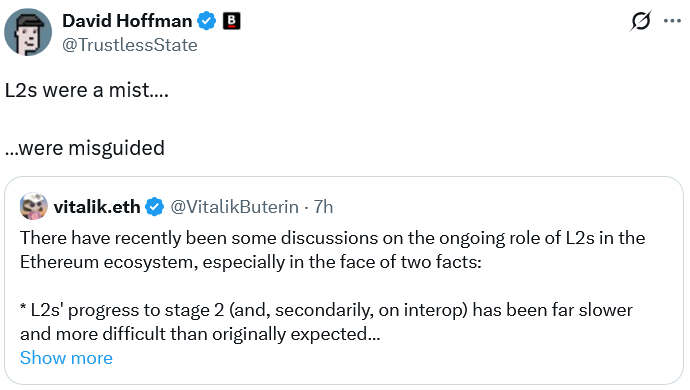
Ethereum co-founder Vitalik Buterin has reversed his long-held view that layer-2s should be the primary way to scale Ethereum, saying the approach “no longer makes sense.”
“We need a new path,” Buterin said in a post to X on Tuesday, arguing that many layer-2s have failed to decentralize and that the Ethereum mainnet is now sufficiently scaling, with improvements coming from gas limit increases and soon native rollups.
“Both of these facts, for their own separate reasons, mean that the original vision of L2s and their role in Ethereum no longer makes sense, and we need a new path.”
Layer-2s were envisioned as extensions of Ethereum, managing most transactions at high speed and low cost while inheriting Ethereum’s security.
Buterin said layer-2s were meant to partake in “Ethereum scaling” by creating block space that is fully secured by the Ethereum mainnet, in which all transactions become valid, uncensored and final; however, many layer-2s have failed to reach that standard, he said:
“If you create a 10000 TPS EVM where its connection to L1 is mediated by a multisig bridge, then you are not scaling Ethereum.”
Buterin said layer-2s — which include Arbitrum, Optimism, Base and Starknet — should instead pivot from scalability to focus on a particular niche, suggesting areas such as privacy, identity, finance, social apps and AI.
Ethereum’s technical roadmap had long focused on layer-2s as the primary avenue for scaling the network.
It also comes as some Ethereum developers have urged a focus on scaling the Ethereum mainnet.
Among them is Max Resnick, a former researcher at the Ethereum infrastructure firm Consensys, who moved to the Solana ecosystem after his push to prioritize scaling the Ethereum mainnet failed to gain enough support.
Ryan Sean Adams, co-host of the Ethereum show Bankless, also expressed support for Buterin’s view, stating: “This is ‘the pivot.’ I’m glad it’s now being said. Strong ETH, Strong L1.”
Native rollups, gas limit rises key scaling Ethereum mainnet
Buterin said he has become increasingly convinced of the role that precompiled native rollups will have in scaling the Ethereum mainnet, particularly once zero-knowledge Ethereum Virtual Machine (zkEVM) proofs are integrated into the base layer.
While traditional rollups are built on top of Ethereum by bundling and executing transactions off-chain before posting transaction data to Ethereum, native rollups are baked into Ethereum itself — meaning the processing of transactions is directly verified by Ethereum validators.
Related: HYPE pops 20% after Hyperliquid team nods prediction markets plan
In mid-December, Ethereum developers also discussed raising the gas limit from 60 million to 80 million once the second blob-parameter-only hard fork was implemented. The hard fork took effect in January.
Doing so would directly increase the number of transactions and smart contract operations that can fit in each Ethereum block, further boosting overall throughput while potentially lowering fees.
Last July, Ethereum researcher Justin Drake unveiled a 10-year plan to achieve 10,000 transactions per second (TPS) on the Ethereum mainnet once all scaling features are implemented, marking a considerable increase from the 15–30 TPS currently observed.
Magazine: A ‘tsunami’ of wealth is headed for crypto: Nansen’s Alex Svanevik
