


Transaction throughput on the Ethereum network is set to be boosted again next month, with developers aiming to increase Ethereum’s gas limit from 60 million to 80 million in January.
Christine Kim, vice president of the research team at Galaxy Digital, shared a summary of the All Core Developers meeting on Monday, in which Nethermind representatives said developers should be ready to move forward with a gas limit increase after the next BPO hard fork on Jan. 7.
Ethereum Foundation developer operations engineer Barnabas Busa, however, noted that two client-level optimizations are needed before another increase in the block gas limit — namely, partial blob responses on the execution layer and the max blobs flag on the consensus layer.
Raising the gas limit directly increases the number of transactions and smart contract operations that can fit in each Ethereum block, boosting overall throughput while potentially lowering fees.
While raising Ethereum’s gas limit to 80 million won’t match the speed or low costs of layer 1s like Solana or Sui, it strengthens Ethereum’s appeal as a secure settlement and execution layer without significantly compromising decentralization — arguably its greatest advantage over competitors.
Ethereum devs will confirm plans early in the new year
Participants in the weekly Ethereum All Core Developers meeting will reconvene on Jan. 5 to confirm when to raise the gas limit following the second BPO hard fork.
The first BPO hard fork came on Dec. 9, which increased blob capacity by 66%; the second hard fork on Jan. 7 is expected to raise this by another 66%.
Blobs on Ethereum are large data chunks that store transaction and rollup data offchain, lowering gas costs and increasing scalability without bloating the network.
Increasing Ethereum’s gas limit has been a priority this year
Increasing Ethereum’s gas limit to expand the network’s execution capacity has been a major focus for developers and researchers this year, with three increases.
Related: Securitize announces ‘real’ tokenized stocks, touts DeFi integration
The first occurred in early February, increasing it from 30 million to 35 million; the second took place in July, rising to 45 million; and the third occurred in late November, reaching 60 million.
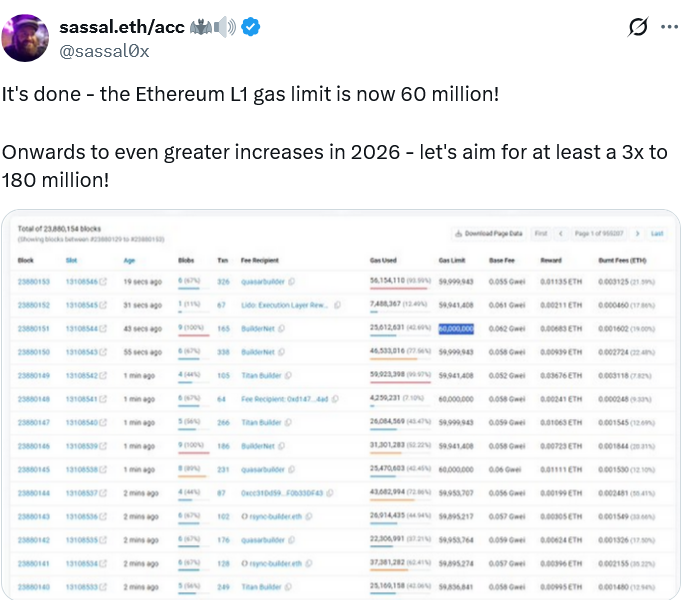
Members of the Ethereum developer and research community have expressed a common goal to raise the network’s gas limit to 180 million by the end of 2026.
Magazine: Meet the onchain crypto detectives fighting crime better than the cops
