

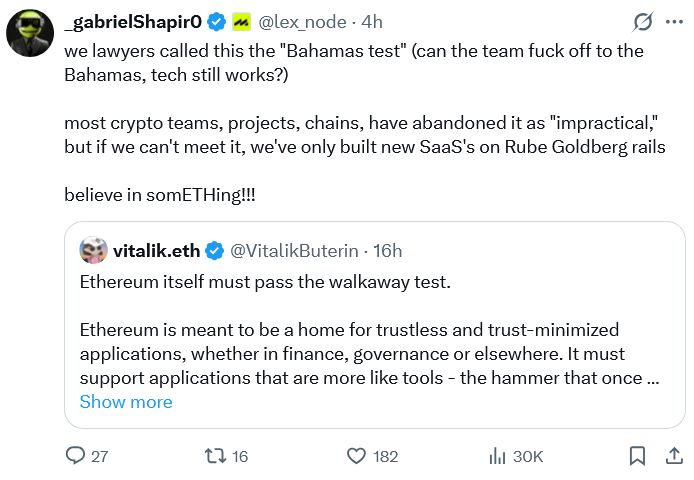
Ethereum needs to get to a point where its value proposition remains even if developers stop active work on the protocol, according to its co-founder Vitalik Buterin.
“We must get to a place where Ethereum’s value proposition does not strictly depend on any features that are not in the protocol already,” said Buterin in a post to X on Monday.
He said Ethereum protocols should aspire to be like hammers: once purchased, they remain usable, unlike services that lose functionality when a vendor walks away.

While Ethereum has a long technical roadmap ahead, the network needs to reach a point where its core features are fully in place, and builders can ossify if they choose, Buterin said.
“Being able to say ‘Ethereum’s protocol, as it stands today, is cryptographically safe for a hundred years’ is something we should strive to get to as soon as possible,” he added.
Vitalik Buterin’s seven areas of improvement
To achieve this, Buterin called for a full quantum-resistance solution to secure Ethereum against future cryptographic threats, while a scalable architecture, including Zero-Knowledge Ethereum Virtual Machines (ZK-EVM) and Peer Data Availability Sampling (PeerDAS), would enable Ethereum to handle thousands of transactions per second.
Buterin added a general-purpose account model for signature validation, a robust gas schedule free of security vulnerabilities, and a block-building model that can resist centralization and censorship pressures, will also crucial to ensure Ethereum stands the test of time.
“Every year, we should tick off at least one of these boxes, and ideally multiple,” in order to “maximize Ethereum’s technological and social robustness for the long term,” he said.
Last week, Buterin said implementing ZK-EVM validation and PeerDAS solutions would give Ethereum greater decentralization, consensus, and high bandwidth — better positioning it to solve the blockchain trilemma that has long forced projects to sacrifice one for the others.
The Splurge part of the Ethereum technical roadmap seeks to implement cryptography solutions that make the network resistant to quantum attacks. No solution has been fully rolled out yet, however.
Related: Bank of Italy models Ethereum risks if ETH value collapsed
“Ideally, we do the hard work over the next few years, to get to a point where in the future almost all future innovation can happen through client optimization, and get reflected in the protocol through parameter changes,” said Buterin.
Ethereum needs better decentralized stablecoins
On Sunday, Buterin also argued that Ethereum needs better decentralized stablecoins to give people greater independence from the traditional finance system.
He suggested a stablecoin backed by a diversified basket of assets and currencies, rather than relying solely on one, like the US dollar, so its stability isn’t dependent on a single nation.
Magazine: One metric shows crypto is now in a bear market: Carl ‘The Moon’
