

Core Scientific (CORZ) reported a $347.2 million first-quarter net loss as its Bitcoin self-mining revenue fell sharply and high-density colocation became its largest revenue source.
In its earnings report published Wednesday, the company reported a net loss of $1.06 per diluted share for the quarter. A year earlier, Core Scientific reported diluted earnings of $1.24 per share.
Core Scientific said the loss included $266.5 million in non-cash impairment charges and a $30.8 million non-cash loss from changes in the fair value of warrants and contingent value rights.
Revenue rose to $115.2 million from $79.5 million a year earlier, but fell short of analyst expectations. Zacks Equity Research said analysts expected $120.2 million in revenue, with Core Scientific’s results coming in about 4.1% below expectations.
The results show Core Scientific’s transition from a Bitcoin miner into an AI infrastructure company, with high-density colocation now generating most of its revenue. The shift gives the company a larger business, but it also highlights how its legacy mining operations have weakened.
Bitcoin mining revenue falls
Core Scientific’s digital asset self-mining revenue fell to $30.1 million from $67.2 million a year earlier, with the company mining 279 Bitcoin (BTC) during the quarter, down 45% from the same period in 2025. According to its 10-Q filing, Core Scientific sold 2,385 Bitcoin during the quarter for $208.3 million to fund planned capital expenditures and other cash needs.
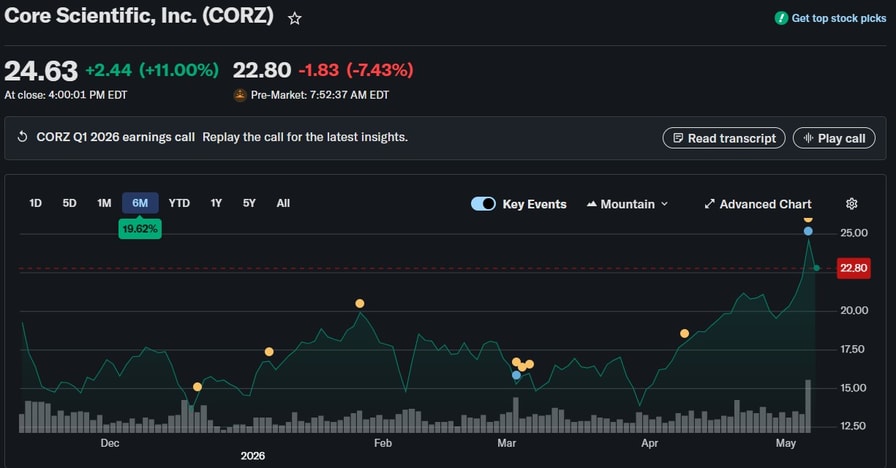
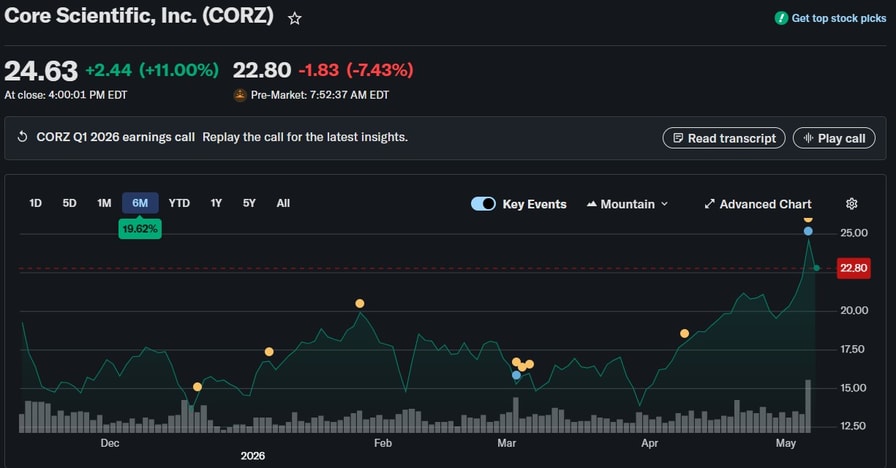
Core Scientific’s six-month price chart. Source: Yahoo Finance
Despite the weaker mining results, Core Scientific’s shares have gained over the past six months. Yahoo Finance data shows CORZ closed at $24.63 on Wednesday, up about 19.6% over six months, before falling 7.43% to $22.80 in pre-market trading at the time of writing.
In a separate announcement, Core Scientific said it plans to scale its Muskogee, Oklahoma, campus to about 1.5 gigawatts of gross power, or about 1.0 gigawatt of leasable power, partly through the planned acquisition of Polaris DS. The company has also started construction on a second, unleased 82.5-megawatt building at the campus.
Related: Trump-linked American Bitcoin reports $82M Q1 loss, revenue miss
Core Scientific expands AI-linked colocation business
Core Scientific’s first-quarter growth came from high-density colocation rather than Bitcoin production, with the company’s mining revenue and Bitcoin output falling while its AI-linked hosting business generated most of its revenue.
The company said its colocation revenue rose to $77.5 million in the first quarter from $8.6 million a year earlier, driven by additional billable customer power capacity delivered during the quarter.
The company said it was billing for 243 megawatts of capacity as of March 31, representing about $350 million in average annualized colocation revenue.
The revenue shift follows a series of hosting agreements with CoreWeave. In June 2024, Core Scientific said it signed 12-year contracts to deliver about 200 megawatts of infrastructure to host CoreWeave’s high-performance computing operations.
The companies later expanded the relationship. In an SEC filing in February 2025, the companies said CoreWeave’s total contracted high-performance computing infrastructure with Core Scientific had increased to about 590 megawatts across six sites.
Magazine: Guide to the top and emerging global crypto hubs: Mid-2026
