Kalshi, Hyperliquid, IB Still Serve Dutch Users as Polymarket Ban Fails to Clear the Market

Dutch users can still access crypto prediction markets despite a previous ban on market leader Polymarket.
Polymarket was banned by the Dutch Gaming Authority (Ksa) in February for operating without a gambling license. However, US-based Kalshi, crypto exchange Hyperliquid and investment giant Interactive Brokers are still offering prediction markets to Dutch users, according to an investigation by Dutch financial newspaper FD.
The Ksa warned that Polymarket’s ban applies to similar platforms. “Websites similar to Polymarket also fall under our supervision and can therefore be sanctioned by us,” a spokesperson reportedly said.
Kalshi appears to be actively targeting the Dutch market, the report said, adding that users can bet on Dutch Eredivisie football matches and previously had the option to speculate on Dutch elections. Hyperliquid, which operates as a decentralized blockchain platform, also recently expanded its prediction market offering to the Netherlands.
Meanwhile, Interactive Brokers frames its products as financial contracts rather than gambling, claiming oversight from the Irish central bank, the report said. However, the Irish central bank told FD it had no knowledge of this arrangement and referred questions to the Irish gambling authority.
Related: Prediction market battle gets closer to Supreme Court
Cointelegraph reached out to Kalshi, Hyperliquid and Interactive Brokers for comment, but had not received a response by publication.
Prediction markets under global scrutiny
Prediction markets are facing a global regulatory reckoning. Last month, Brazil moved to shut down 27 platforms, including Kalshi and Polymarket. A growing number of European nations, among them France, Italy, Singapore, Switzerland and Poland have also blocked or penalized platforms operating without authorization. Hungary and Portugal have also moved against Polymarket specifically.
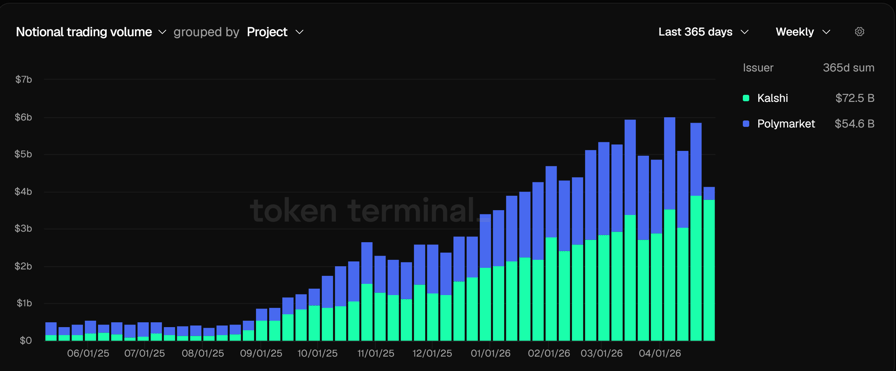
Prediction markets volume. Source: Token Terminal
In the United States, the picture is more fractured. A federal-versus-state battle has broken out over who has the authority to regulate prediction markets. The CFTC has filed lawsuits against Illinois, Arizona, Connecticut, New York and Wisconsin in recent weeks alone, arguing those states overstepped by attempting to regulate markets that fall under federal jurisdiction.
Venture capital firm a16z backed the federal position, arguing that forcing exchanges to block users based on their state of residence directly conflicts with the CFTC’s impartial access rules.
Related: Kalshi, Polymarket among 27 prediction platforms banned in Brazil
Most traders lose money on prediction markets
An April research from the London Business School found that only 3% of prediction market participants make consistent profits, while nearly 70% lose money.
There is also the issue of insider trading in prediction markets. Anonymous traders were found to have correctly bet on the US attack on Iran and the attempted kidnapping of Venezuelan President Nicolás Maduro, raising suspicions of advance knowledge.
Magazine: How to fix suspected insider trading on Polymarket and Kalshi
